

Smartphone

Automotive Electronics

Chip Manufacturers

Consumer Electronics

IEEE 802.15.4a

IEEE 802.15.4z

IEEE 802.15.4ab
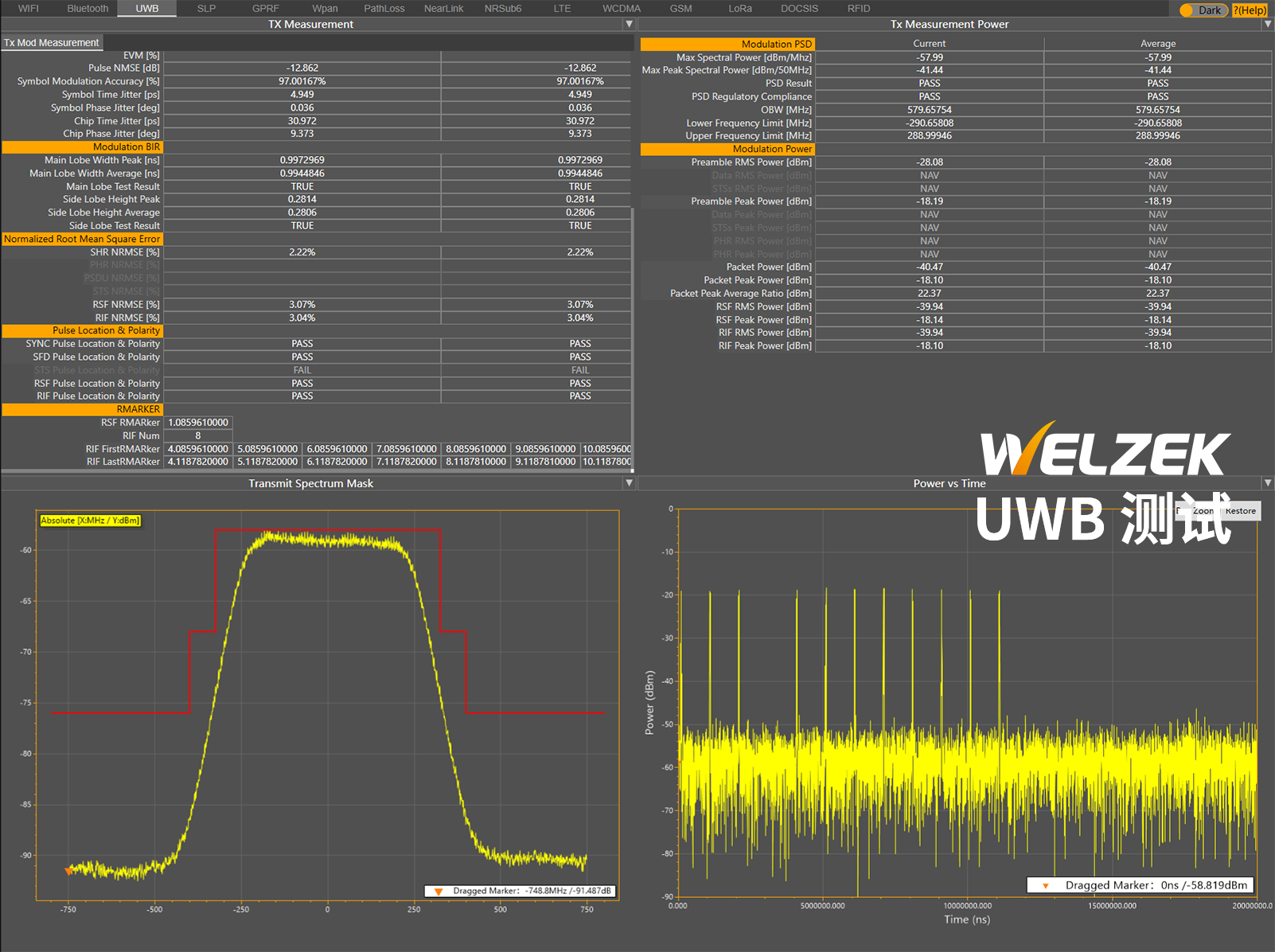
UWB (Ultra-Wideband) is a carrier-free, impulse-based short-range wireless technology for communication and positioning. Instead of using continuous sine carriers, it transmits data via nanosecond-scale narrow pulses, with a typical signal bandwidth of 500MHz and operating frequency ranging from 3.1GHz to 10.6GHz.
UWB’s core advantage is centimeter-level high-precision positioning. By measuring Time of Flight (ToF) and Time Difference of Arrival (TDoA), positioning errors can be as low as 10 cm—far surpassing the meter-level accuracy of Bluetooth and Wi‑Fi. In addition, UWB features low power consumption, strong interference immunity, and high security, with low signal power that is difficult to intercept, making it well-suited for complex indoor environments.
The UWB technology framework continues to evolve under the IEEE 802.15.4 standard family. Starting with 802.15.4a, which established the foundation for impulse-radio UWB, to 802.15.4z that enhanced secure ranging for high-security applications such as automotive keyless entry, the latest standards have achieved breakthroughs in communication rate, ranging distance, and integrated sensing capabilities. This evolution focuses on four key dimensions: accuracy, security, distance, and data rate, continuously expanding UWB’s application boundaries across consumer electronics, smart vehicles, and industrial IoT.
IEEE 802.15.4a – August 2007. The first widely adopted UWB PHY standard, focused on low-rate, low-power precision positioning and ranging. It laid the foundation for UWB in industrial and IoT applications.
IEEE 802.15.4z – Second half of 2020. Enhanced PHY security based on 802.15.4a, introducing advanced coding and encryption. This makes UWB well-suited for high-security scenarios such as digital car keys and mobile payments.
IEEE 802.15.4ab – Expected in Q2 2026. Referred to as “next-generation UWB,” it delivers comprehensive upgrades in data transmission, positioning accuracy, and radar sensing, aiming to improve link stability and ranging distance.
IEEE 802.15.4ab RF Test
IEEE 802.15.4ab is a PHY enhancement standard for UWB. It upgrades RF and modulation capabilities based on 802.15.4z while remaining backward compatible with legacy devices.
Key features:
Higher Pulse Repetition Frequency (HPRF) – improves ranging rate.
Multi-Millisecond (MMS) UWB ranging – enhances ranging accuracy and range.
Sensing capabilities – supports presence detection and environment mapping.
Dynamic PHR format – introduces PHR1 and PHR2, supporting both BCC and LDPC encoding.
Backward compatibility – works with 802.15.4z and 802.15.4a, plus coexistence mechanisms (non-interfering) with Wi‑Fi and Bluetooth.
UWB Test Requirements Upgrade
IEEE 802.15.4ab introduces stricter requirements for UWB testing:
HPRF and High-Speed PHY Testing – Supports data rates up to 124.8 Mbps and dynamic BCC/LDPC encoding. Test equipment must offer higher sampling rate, wider analysis bandwidth, and real-time decoding of dynamic PHR and STS security sequences.
MMS Multi‑Segment Continuous Testing – Requires continuous measurement of multiple ranging segments over UWB’s large bandwidth. Compared to single‑packet measurements, accurate frequency measurement becomes more critical. Additionally, UWB signals must switch rapidly between narrowband and UWB frequencies, adding narrowband frequency measurement to traditional UWB tests. This demands equipment that can precisely identify both frequency types, significantly increasing accuracy requirements.
Sensing Capability Testing – The new sensing feature requires test systems to support continuous CIR acquisition and micro‑motion target simulation.
WELZEK UWB Test Solution
The T6290F Wireless Tester features high frequency and large bandwidth, covering a frequency range from 5 MHz to 10 GHz with an analysis bandwidth of up to 2 GHz. It fully meets UWB test requirements, supports all UWB channels (CH0–CH15), and has extensive UWB testing experience in R&D labs and production lines across chips, smartphones, automotive, and consumer electronics.
UWB test option – supports MMS testing
FiRa certified – PHY conformance test versions 1.0 through 4.0
Integrated testing – supports UWB TX/RX combined solutions
Comprehensive test types – supports OTA, AOA, and TOF for UWB
Full channel support – covers all UWB channels CH0 to CH15

MMS (Multi-Millisecond) is a key technology in IEEE 802.15.4ab. It improves UWB ranging accuracy and range, enhancing UWB's practicality.

T6290F has passed FiRa PHY Conformance Certification for versions 1.0 to 4.0.

Complete Test Solution.

Innovation-Driven R&D, Expanding Product Capabilities.